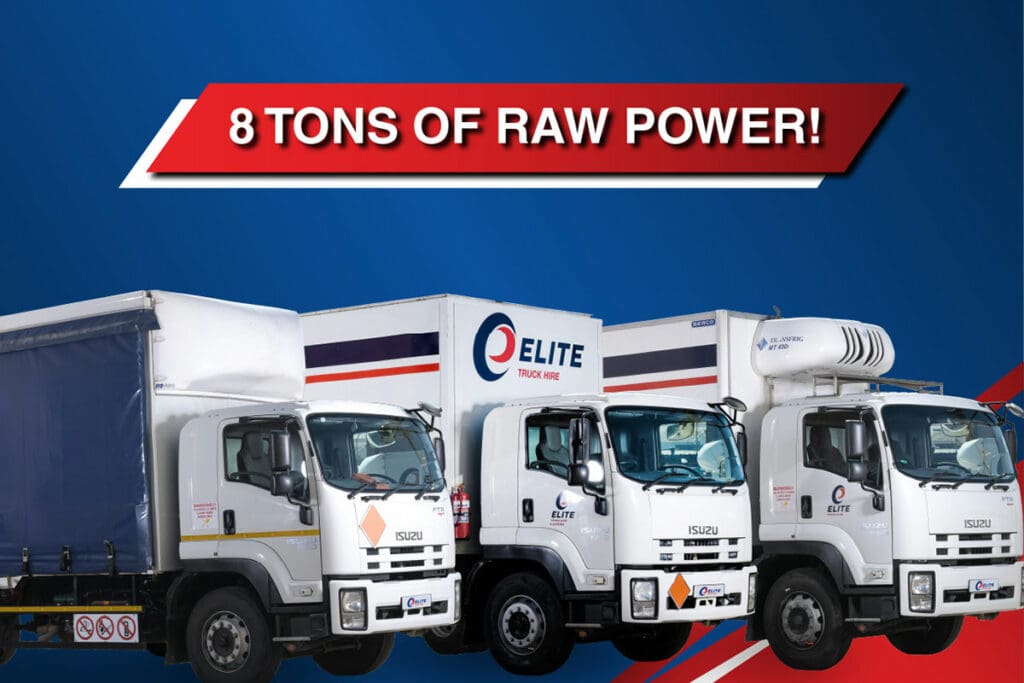
8-Ton Truck Hire That Works as Hard as You Do
The 8-ton is the size most South African businesses end up on, and it is usually the right call. It sits at the point where payload becomes genuinely useful for bulk work while the vehicle is still manageable in traffic, on ordinary access roads and in a standard loading bay.
But “8 ton” gets misread more often than any other size in the fleet. Here is what one actually carries, the configurations available, and how to tell whether it is the right size for your load or whether you should be looking either side of it.
What "8 ton" actually means
The figure refers to payload — roughly what you can put on the back. It is not the weight of the truck, and it is not the combined weight of truck and load.
Three numbers matter:
- Tare — the empty weight of the vehicle
- GVM (Gross Vehicle Mass) — the maximum legal weight fully loaded
- Payload — GVM minus tare, which is your usable capacity
So an 8-ton truck carries around eight tons of cargo, while the loaded vehicle on the road weighs considerably more. If you are working to a site weight restriction, a bridge limit or a weighbridge, GVM is the number you need, not the tonnage in the name.
Weight is only half the question
A load can run out of space long before it runs out of weight allowance. That is the difference between weighing out and cubing out.
Dense cargo, bricks, sand, tiles, cement, bottled liquid, hits the 8-ton payload limit while the deck is still half empty. Light bulky cargo, furniture, packaging, insulation, empty crates, boxed retail stock, fills the deck long before the truck is anywhere near capacity.
If your load is light and bulky, the deciding number is deck length and internal volume, not the eight tons. Plenty of businesses book an 8-ton for a load that a 4-ton would have carried on weight, but needed the 8-ton deck to fit.
The five 8-ton configurations
Two 8-ton trucks can be completely unsuited to each other’s work. The body determines how the load goes on and off, and that usually decides the job.
8-ton drop side — open sides that fold down for loading from any angle or straight off a forklift. Right for bricks, sand, pallets and construction materials. Not suitable for anything that has to stay dry or secure.
8-ton panel van — fully enclosed and lockable. Right for electronics, furniture, boxed stock and anything weather-sensitive or theft-prone. Loading is through the rear only, which costs you time on palletised work.
8-ton curtain side — enclosed like a panel van, but the sides draw back for full-length forklift access. The compromise for palletised goods that also need protecting, and usually the fastest to turn around at a busy bay.
8-ton drop side with crane — a vehicle-mounted crane, so you can lift and place heavy or awkward items without a forklift or a second machine at the destination. Worth it whenever the far end has no lifting equipment. See crane truck hire for the full configuration.
8-ton refrigerated — temperature-controlled for perishables, fresh produce, meat and pharmaceutical loads. Widely used between production facilities, cold storage, retailers and restaurants. See refrigerated truck hire for details.
When 8 tons is the right size
The 8-ton earns its place on:
- Bulk deliveries that are too heavy for a 4-ton but do not justify a 12
- Construction material runs to site
- Regional and intercity route work
- Palletised distribution where a forklift is available at one or both ends
- Cold chain work between production and retail
When it isn't
Step down to a 4-ton if you are consistently running half-loaded, working in tight urban delivery, or dealing with access that a larger vehicle struggles with. An oversized truck costs more to hire, more to run and is slower door to door in congested work.
Step up to a 12-ton if you are cubing out on volume rather than weight, or regularly splitting loads across two trips.
Step up to a truck tractor and trailer for genuine long-haul or high-volume freight — but note this is a bigger jump than the tonnage suggests. Turning circle, site access and driver licensing all change.
And if one job a month needs the bigger vehicle while the rest do not, hire the smaller one and book up for the day you need it. That is the point of renting rather than owning.
Check the far end before you book
Access has stopped more deliveries than payload ever has. Before confirming an 8-ton, check gate width, turning space, overhead clearance, loading bay height and any road weight limits at the destination. It takes five minutes and saves an entire wasted trip.
Also account for packaging. Pallets, crates, strapping and wrapping all add weight and take deck space, and on a full load that is not a rounding error.
Book an 8-ton
If you can describe the load, the route and the access at both ends, our team will confirm whether the 8-ton is the right fit or point you to the size that is. That conversation happens every day and it is a great deal cheaper than a second trip.
View the full fleet to compare configurations, or request a quote and tell us what you are moving.